

The sun rises early and lingers late. Daylight stretches across the sky like a golden ribbon. The Summer Solstice 2027 brings the longest stretch of light all year. People have marveled at it for thousands of years.
This day is more than a mark on the calendar. It is a turning point in Earth’s yearly trip around the sun. Ancient builders lined up giant stones to catch its first rays. Today, millions still gather to greet the dawn.
You may wonder why this day feels so magical. The answer mixes science, history, and pure wonder. Surprising facts hide behind every sunrise. Some of them may change how you see the sky.
This guide shares everything you need to know. You will learn the date, the science, the traditions, and the myths. You will also find travel ideas, fun facts, and easy ways to celebrate. Let us step into the light together.
What is the Summer Solstice 2027?
The Summer Solstice is the moment one hemisphere tilts most toward the sun. In the Northern Hemisphere, it brings the longest daylight of the year. It also marks the astronomical start of summer.
The word solstice comes from Latin. Sol means sun, and sistere means to stand still. At this point, the sun seems to pause in the sky before it slowly turns back. Ancient observers saw this pause and built whole belief systems around it.
- It happens twice a year, once in each hemisphere.
- The Northern Hemisphere sees it in June.
- The Southern Hemisphere sees it in December.
- It is an exact moment, though people celebrate the whole date.
- The sun reaches its highest point in the sky for the year.
- The sun’s path across the sky is at its widest and longest.
- It is one of four key sky events, along with the winter solstice and two equinoxes.
In simple words, it is the day the sun reaches its farthest point north. After that, the sun begins a slow journey back south. Daylight shrinks a little each day from then on.
Date and Exact Timing of Summer Solstice 2027
In 2027, the June solstice falls on Monday, June 21. The exact moment arrives at about 14:11 UTC. The clock time changes depending on where you live. Always check your local time before you plan an event.
Here is how the moment looks around the world:
- London, UK: about 3:11 pm BST
- New York, USA: about 10:11 am EDT
- Chicago, USA: about 9:11 am CDT
- Los Angeles, USA: about 7:11 am PDT
- Sydney, Australia: about 12:11 am on June 22, the winter solstice there
The date can shift between June 20 and June 22 from year to year. This happens because a calendar year does not match Earth’s orbit perfectly. Leap years help reset the pattern every four years.
The exact minute of the Summer Solstice is not something you can see. It is a calculation based on the sun’s position. Still, most people celebrate at sunrise or sunset. Those moments are easy to share and look beautiful.
How Long is the Summer Solstice?
The solstice itself lasts only a single instant. It is the exact second the sun reaches its farthest point north. The day around it is what we call the longest day. Most people use the word for the whole date.
The amount of daylight depends on your latitude. The farther north you travel, the longer the sun stays up. Close to the equator, the change is almost zero.
- London: about 16 hours and 38 minutes of daylight
- New York: about 15 hours and 5 minutes
- Reykjavik, Iceland: about 21 hours
- Anchorage, Alaska: about 19 hours and 20 minutes
- Arctic Circle: a full 24 hours of sunlight
- Equator: close to 12 hours, the same as every other day
Twilight also lasts much longer at high latitudes. In parts of northern Europe, the sky never turns fully dark. People call these glowing nights white nights.
Why Summer Solstice Happens (Scientific Explanation)
The cause is simple. Earth is tilted on its axis by about 23.4 degrees. This tilt, not distance from the sun, creates our seasons. Without it, every day would feel the same all year.
As Earth circles the sun, the tilt keeps pointing in the same direction. In June, the Northern Hemisphere leans toward the sun. Sunlight hits it more directly and for more hours each day.
- The sun’s rays strike at a steeper angle, which warms the ground faster.
- Days grow longer as the Northern Hemisphere tilts toward the light.
- The Southern Hemisphere leans away and enters winter.
- At noon, the sun sits directly overhead along the Tropic of Cancer.
- After the Summer Solstice, daylight slowly shrinks again.
- The change in daylight is slowest around the solstice, which is why the sun seems to stand still.
Earth is actually farthest from the sun in early July. This point is called aphelion. It proves that tilt, not distance, controls the seasons.
A good way to picture it is a spinning top that leans to one side. As it travels around a room, the lean always points the same way. Sometimes the lean faces the lamp, and sometimes it faces away.
History and Cultural Significance
Early humans watched the sky closely. Farmers needed to know when to plant and harvest. The sun’s cycle became their calendar and, often, their religion.
Many ancient cultures built monuments to track it. They saw the longest day as a time of power, fertility, and renewal. Feasts, dances, and fires were common across the world.
- Stonehenge in England aligns with the solstice sunrise.
- Egyptians watched the sun set between the great pyramids at Giza.
- Native American peoples marked the day with ceremonies and dances.
- The Celts and Norse lit bonfires to boost the sun’s strength.
- Christians later linked the day to the feast of St. John the Baptist.
- Ancient Slavic peoples celebrated Kupala Night with wreaths and fire jumping.
- Chinese traditions linked the day to yin and yang, with the sun at peak yang.
Midsummer festivals grew from these old customs. Many are still alive today. Modern events often blend old rituals with music, food, and family fun.
Importance of Summer Solstice 2027
The Summer Solstice reminds us that life follows cycles. It also has real meaning for nature, farming, and wellbeing. Long days give plants more time to grow and bloom.
For many people, it is a day for reflection and joy. It invites us to slow down and enjoy the light. The mood of the day is warm, hopeful, and social.
- It marks the peak of the sun’s power in the north.
- It helps farmers and gardeners plan their seasons.
- It boosts mood for many people thanks to extra daylight.
- It brings communities together through festivals and gatherings.
- It offers a natural moment to set goals and let go of old habits.
- It supports wildlife, from bees to birds, with long feeding hours.
- It connects modern people with ancient traditions.
Some people also use it as a symbol of balance. After the peak comes a gentle turn toward autumn. That idea reminds us that every high point is part of a cycle.
🇬🇧 UK Celebrations of Summer Solstice 2027
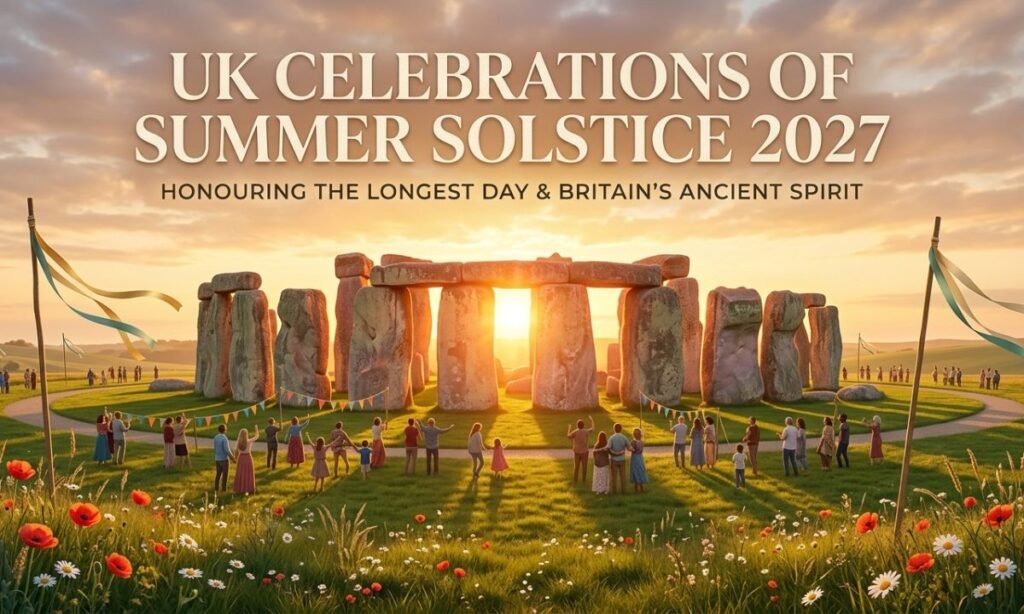
Britain is famous for its solstice traditions. Thousands travel to ancient sites to watch the sun rise. The mood is peaceful, musical, and full of wonder.
Stonehenge is the most popular spot. English Heritage usually opens the site for free solstice access, though visitors should check current rules before traveling. Parking and facilities are often limited, so plan early.
- Sunrise at Stonehenge arrives around 4:52 am.
- Crowds gather with drums, flowers, and chanting.
- Avebury stone circle hosts quieter gatherings.
- Glastonbury sees rituals, walks, and sunrise hikes.
- Cornwall and Scotland hold bonfires and community events.
- The Callanish Stones on the Isle of Lewis draw visitors seeking solitude.
- Local parks and beaches host yoga, picnics, and sunrise swims.
Pack warm layers, even in June. Early mornings can feel chilly before the sun climbs. Bring water, a flask of tea, and a small blanket for comfort.
🇺🇸 USA Celebrations of Summer Solstice 2027

America celebrates in colorful and creative ways. Some events honor ancient astronomy, while others are pure fun. The Summer Solstice is a beloved reason to be outdoors.
- Fairbanks, Alaska hosts the Midnight Sun Festival, with food, music, and games.
- The Alaska Goldpanners play a baseball game at night without stadium lights.
- Santa Barbara, California holds a famous parade and festival around the date.
- Yoga events fill public spaces, including Times Square in New York.
- Make Music Day takes place on June 21 with free concerts in many cities.
- Chaco Canyon in New Mexico features a sun marker that follows the solstice light.
- Many national parks offer sunrise hikes and ranger talks.
Many towns also host farm dinners, night hikes, and sunset picnics. Beach bonfires and rooftop gatherings are popular too. Check local event pages for the latest schedules and rules.
Global Celebrations of Summer Solstice 2027
Around the world, cultures greet the longest day with fire, flowers, and feasting. Each country adds its own flavor. The shared theme is gratitude for light.
- Sweden: Midsommar is celebrated on Friday, June 25, 2027, with maypoles, flower crowns, and herring.
- Finland: Juhannus brings lakeside bonfires and saunas.
- Norway: Sankthansaften on June 23 features coastal bonfires.
- Latvia and Estonia: Midsummer nights bring songs, wreaths, and dancing.
- Iceland: Locals hike and party under the midnight sun.
- Poland: Wianki lets people float flower wreaths down rivers.
- Peru: Inti Raymi honors the sun god, though it marks the winter solstice there.
Each festival is a reminder that people everywhere love the sun. Even when customs differ, the feeling of joy feels the same.
Fun Facts About Summer Solstice 2027
Here are some amazing facts that surprise most people. They show how strange and beautiful this day can be.
- The longest day is not the hottest day. Oceans and land take weeks to warm up, a delay called seasonal lag.
- The earliest sunrise usually happens a few days before the solstice.
- The latest sunset comes a few days after it.
- The sun does not set at all above the Arctic Circle.
- Midday shadows are at their shortest in the Northern Hemisphere
- Some animals change behavior because of longer days.
- The Summer Solstice has inspired art, poetry, and even Shakespeare’s A Midsummer Night’s Dream.
- The June full moon often hangs low in the sky near the solstice, which makes it look huge and golden.
Surprising Myths About the Summer Solstice
Many popular beliefs about this day are not quite true. Clearing them up makes the story even better.
- Myth: Earth is closest to the sun on this day. Fact: Earth is actually near its farthest point in early July.
- Myth: It is the hottest day of the year. Fact: The hottest weather often arrives in July or August.
- Myth: The sun rises due east and sets due west. Fact: It rises far to the northeast and sets far to the northwest.
- Myth: The longest day has the earliest sunrise. Fact: Sunrise times peak slightly earlier, a few days before.
- Myth: Everyone gets the same summer start date. Fact: Meteorological summer starts on June 1, while astronomical summer starts at the solstice.
- Myth: The sun stops moving for a full day. Fact: It only seems to pause for a few days because its path changes very slowly.
Places Where the Sun Never Sets
Some places around the world enjoy a true midnight sun. Travelers visit them just to feel it. Time becomes a strange, dreamy thing.
- Tromso, Norway: the sun stays up from late May to late July.
- Longyearbyen, Svalbard: nearly four months of constant daylight.
- Fairbanks, Alaska: almost no real darkness during the solstice.
- Murmansk, Russia: a well-known midnight sun city.
- Northern Finland and Sweden: golden light glows at midnight.
- Iceland: it never gets fully dark, even when the sun dips below the horizon.
People in these places often sleep with blackout curtains. Many say the endless light gives them a rush of energy. Some locals hike, fish, and play sports at midnight.
Ancient Monuments Aligned With the Summer Solstice
Our ancestors were skilled sky watchers. They built huge structures that frame the sun on the longest day. Many of these sites still hold mysteries.
- Stonehenge, England: its main axis points to the solstice sunrise.
- Giza, Egypt: the sun sets between two great pyramids when viewed from the Sphinx.
- Chaco Canyon, New Mexico: a spiral carving catches a dagger of light.
- Machu Picchu, Peru: its temples line up with key sun events.
- Callanish Stones, Scotland: this circle tracks the moon and sun.
- Cahokia, Illinois: a woodhenge once marked the sun’s path.
These builders had no modern tools, yet their timing was precise. Their work shows how deeply the sky shaped early life. Visiting one of these places on the right day feels like touching history.
Easy Ways to Celebrate the Summer Solstice at Home
You do not need a big trip to enjoy this day. A few simple ideas can turn it into a lovely memory. Try one or two that fit your style.
- Wake up early and watch the sunrise with a warm drink.
- Host a long garden dinner and stay outside until dusk.
- Make a flower crown with fresh blooms.
- Light a small bonfire or a few candles in the evening.
- Write goals for the second half of the year.
- Go for a sunset walk and take photos.
- Cook seasonal food like berries, grilled veggies, and fresh salads.
- Plant a herb or flower to mark the day.
- Switch off screens for an hour and simply watch the sky.
Kids can join in too. Let them paint suns, build mini stone circles, or track their own shadows through the day.
Social Media Captions & Trends 2027
Sharing your solstice moments is part of the fun. A great photo and a short caption can reach many people. Tags help your post join the global conversation.
- Longest day, brightest vibes. Happy Summer Solstice 2027!
- Chasing every minute of sunlight today.
- Golden hour never ends on the longest day.
- The sun stood still, and so did my heart.
- Here comes the sun, and it is staying late.
- Summer begins, and so does the magic.
- Sun-kissed and solstice blessed.
- Light up the longest day with good people.
- Sunrise to sunset, I am soaking it all in.
Popular hashtags include #SummerSolstice, #LongestDay, #Midsummer, #GoldenHour, and #SunriseVibes. Posting at sunrise or sunset often gets the best response. Short videos of golden light also perform well.
Frequently Asked Questions About Summer Solstice 2027
When is the Summer Solstice 2027?
It falls on Monday, June 21, 2027, at about 14:11 UTC. Local times vary by time zone.
Is the Summer Solstice the longest day of the year?
Yes, in the Northern Hemisphere it has the most daylight. The Southern Hemisphere has its shortest day.
Is the Summer Solstice the first day of summer?
Astronomically, yes. Meteorologists mark summer from June 1.
Why is it called the solstice?
The word comes from Latin for sun standing still. The sun seems to pause before changing direction.
Is it the hottest day of the year?
No, the warmest days usually come later. Land and sea need time to heat up.
Where can I see the best Summer Solstice celebrations?
Stonehenge in England and Midsommar in Sweden are famous. Alaska also offers amazing midnight sun events.
Do all countries celebrate on the same day?
Most celebrate near June 21. Some, like Sweden, hold festivals on the nearest weekend.
What happens in the Southern Hemisphere?
They have their winter solstice and the shortest day of the year. Their longest day comes in December.
Final Thoughts
The Summer Solstice is a gift of light and time. It reminds us how closely we are tied to the sun and the seasons. Ancient people knew it, and we can feel it too. A single day can fill us with wonder.
Whether you travel to a stone circle or sit in your backyard, take a moment. Watch the sky, breathe deeply, and enjoy the glow. The Summer Solstice 2027 is a chance to pause and appreciate life. Make it a day you will remember.
